Youtube

YouTube Has a Firm Grip on Daytime TV (nytimes.com) 34

YouTube has been winning the streaming wars for years, but its real competitive advantage comes not from prime-time viewing but from its stranglehold on daytime hours when Americans are meditating, exercising, cooking, or simply looking for background noise. At 11 a.m. in October, YouTube commanded an average audience of 6.3 million viewers compared to Netflix's 2.8 million, according to Nielsen data. Amazon drew about a million viewers at that hour, and HBO Max, Paramount+ and Peacock each pulled fewer than 600,000.

The gap narrows significantly at night -- Netflix's audience swells to over 11 million at 9 p.m., trailing YouTube's 12 million -- but YouTube's dominance reasserts itself in overnight hours and through the next day. Netflix is responding by bringing at least 34 video podcasts to its service next year, including "The Breakfast Club," "The Bill Simmons Podcast," and "Pardon My Take." Amazon added the Kelce brothers' "New Heights" podcast to Prime Video in September. The strategy is intentional: roughly 75 percent of all podcast listening happens between 6 a.m. and 6 p.m., according to Edison Research. YouTube said viewers watched 700 million hours of video podcasts on living room devices in October alone, a 75% increase from the previous year.
Piracy

LimeWire Re-Emerges In Online Rush To Share Pulled '60 Minutes' Segment (arstechnica.com) 128

An anonymous reader quotes a report from Ars Technica: CBS cannot contain the online spread of a "60 Minutes" segment that its editor-in-chief, Bari Weiss, tried to block from airing. The episode, "Inside CECOT," featured testimonies from US deportees who were tortured or suffered physical or sexual abuse at a notorious Salvadoran prison, the Center for the Confinement of Terrorism. "Welcome to hell," one former inmate was told upon arriving, the segment reported, while also highlighting a clip of Donald Trump praising CECOT and its leadership for "great facilities, very strong facilities, and they don't play games."

Weiss controversially pulled the segment on Monday, claiming it could not air in the US because it lacked critical voices, as no Trump officials were interviewed. She claimed that the segment "did not advance the ball" and merely echoed others' reporting, NBC News reported. Her plan was to air the segment when it was "ready," insisting that holding stories "for whatever reason" happens "every day in every newsroom." But Weiss apparently did not realize that the "Inside CECOT" would still stream in Canada, giving the public a chance to view the segment as reporters had intended.

Critics accusing CBS of censoring the story quickly shared the segment online Monday after discovering that it was available on the Global TV app. Using a VPN to connect to the app with a Canadian IP address was all it took to override Weiss' block in the US, as 404 Media reported the segment was uploaded to "to a variety of file sharing sites and services, including iCloud, Mega, and as a torrent," including on the recently revived file-sharing service LimeWire. It's currently also available to stream on the Internet Archive, where one reviewer largely summed up the public's response so far, writing, "cannot believe this was pulled, not a dang thing wrong with this segment except it shows truth."
"Yo what," joked Reddit user Howzitgoin, highlighting only the word "LimeWire." Another user responded, "man, who knew my nostalgia prof pic would become relevant again, WTF."

"Bringing back LimeWire to illegally rip copies of reporting suppressed by the government is definitely some cyberpunk shit," a Bluesky user wrote.

"We need a champion against the darkness," a Reddit commenter echoed. "I side with LimeWire."
Television

Samsung's 2026 Gaming Monitors Promise 6K, 3D, and Up To 1,040Hz (theverge.com) 44

An anonymous reader shares a report: Samsung is breaking new ground with its 2026 lineup of gaming monitors, with the Odyssey 3D G90XH becoming the first to feature a 6K display with "glasses-free 3D." The new monitor comes with a 32-inch IPS panel, offering real-time eye-tracking that "adjusts depth and perspective" based on your position, along with a speedy 165Hz refresh rate that you can boost to 330Hz with a Dual Mode feature that switches to 3K.

[...] A 6K 3D display isn't the only notable upgrade coming to Samsung's lineup; the company is launching the Odyssey G6 G60H, which it says is the "world's first" 1,040Hz gaming monitor. The 27-inch monitor only supports this ultra-fast refresh rate in HD, while its native 1440p resolution still offers speeds up to a very fast 600Hz. It's also compatible with AMD FreeSync Premium and NVIDIA G-Sync.

The Almighty Buck

Larry Ellison Pledges $40-Billion Personal Guarantee For Paramount's Warner Bros Bid (yahoo.com) 45

Oracle co-founder Larry Ellison has personally guaranteed $40.4 billion to shore up Paramount's bid for Warner Bros. Discovery, trying to ease financing doubts as Warner Bros weighs a rival offer from Netflix. Reuters reports: Paramount said the amended terms do not change the $30-per-share all-cash offer even as the fight for Hollywood's sought-after assets heats up, with control of Warner Bros' vast library offering a decisive edge in the streaming wars. "I doubt many Warner Bros shareholders that are on the fence or planning to vote no "were holding out due to issues the "revised bid addresses such as a guarantee from Larry Ellison on the funding front," said Seth Shafer, principal analyst at S&P Global.

As part of the revised terms, Ellison also agreed not to revoke the family trust or transfer its assets during the pendency of the transaction, the filing showed. Paramount said it has raised its regulatory reverse termination fee to $5.8 billion from $5 billion to match the competing transaction and extended the expiration date of its tender offer to January 21, 2026.

The "bid follows Warner Bros asking its shareholders to reject the $108.4 billion offer from Paramount for the whole company, including cable TV assets, on doubts over its financing and the lack of a full guarantee from the Ellison family. But Warner Bros investors, including the fifth largest shareholder Harris Associates, have said they would be open to revised offers from Paramount if it presents a superior bid and addresses issues with deal terms. Under the Netflix agreement, Warner Bros would owe Netflix $2.8 billion as breakup fee if it walks away from that deal.

XBox (Games)

Is Xbox Betting on Cross-Platform Gaming? (cnbc.com) 26

A "slew of layoffs, price hikes and studio closures" for Microsoft's Xbox "have led many to declare — not for the first time — that the Xbox is dead," reports CNBC.

Or is it just changing its business model? The company's overall gaming revenue decreased 2% year-over-year, with a 29% dip in Xbox hardware sales, according to Microsoft's first-quarter earnings for fiscal 2026. The broader console industry has been in a major slump, with hardware spending down 27% year-over-year in November, which is typically a busy shopping month, according to a recent report from research firm Circana. It was the worst November in two decades, IGN reported, citing Circana data. Combined Switch and Switch 2 unit sales were down more than 10% during the month and PS5 sales were down more than 40%, IGN said. But the Xbox Series hardware took the biggest beating, with a dramatic 70% drop in sales...Microsoft's Xbox Series S and Series X, at 1.7 million units, couldn't outsell the original Nintendo Switch, which launched in 2017 and has sold 3.4 million units so far this year, data from game sales tracking site VGChartz estimated...

Microsoft CEO Satya Nadella said in a recent interview with the TBPN podcast that the company's gaming business model will look to be "everywhere in every platform," from consoles to TV to mobile. His comments also hinted that the next Xbox may function more like a PC. "It's kind of funny people think about the console and PC as two different things," Nadella said. "We built a console because we wanted to build a better PC, which could then perform for gaming. So I kind of want to revisit some of that conventional wisdom...." A source familiar with Xbox strategy told CNBC that the company is looking at creating an open system that enables players to jump between console, PC and cloud gaming — and any form of entertainment beyond gaming. [Wedbush analyst Michael Pachter told CNBC] that while Microsoft is not completely abandoning hardware, the company is splitting its audience into existing buyers interested in specialized consoles and everyone else.

Xbox Game Pass subscription service, which gives subscribers access to games from a variety of publishers, is a clear example of this strategy... The growth in cloud gaming has been blistering. Xbox reported a record 34 million Game Pass subscribers in 2024 and a total Game Pass revenue of almost $5 billion over the last fiscal year. Xbox said in a November blog post that the number of cloud gaming hours from Game Pass subscribers was up 45% compared to the same time last year. The Microsoft subsidiary also said console players are "spending 45% more time cloud streaming on console and 24% more on other devices..."

Despite gaming's scaling limitations, Microsoft seems committed to doing what it has done with the rest of its products — moving it to the cloud... [Xbox President Sarah] Bond recently said in an interview with Mashable that the idea of exclusive games is "antiquated" as the company has leaned into cross-platform gaming... Xbox is betting that cloud and cross-platform gaming are the future. For a decade, claims have been made about the death of the Xbox, and what comes next could fully spell the end, or bring a metamorphosis.

Television

2025 Was the Beginning of the End of the TV Brightness War (theverge.com) 56

The television industry's brightness war may have hit its inflection point in 2025, the year TCL and Hisense released the first consumer TVs capable of 5,000 nits under specific settings -- a figure that would have seemed absurd not long ago when manufacturers struggled to reach 2,000 nits. LG introduced Primary RGB Tandem OLED technology, moving from a three-stack panel design to a four-stack red-blue-green-blue configuration that the company claims can achieve 4,000 nits. The technology appears in the LG G5, Panasonic Z95B and Philips OLED950 and OLED910.

RGB mini-LED also emerged as a new category. The technology uses individual small red, green and blue LED backlights instead of white or blue LEDs paired with quantum dots. Hisense demonstrated it at CES 2025, TCL announced its Q10M for China, and Samsung unveiled its own version called micro-RGB. These sets range from $12,000 to $30,000. Sony has confirmed it will debut RGB TV technology in spring 2026. HDR content is currently mastered at a maximum of 4,000 nits. The situation echoes the audio industry's loudness war, The Verge points out, which peaked with Metallica's heavily compressed Death Magnetic in 2008.
United Kingdom

UK Actors Vote To Refuse To Be Digitally Scanned In Pushback Against AI 44

An anonymous reader quotes a report from the Guardian: Actors have voted to refuse digital scanning to prevent their likeness being used by artificial intelligence in a pushback against AI in the arts. Members of the performing arts union Equity were asked if they would refuse to be scanned while on set, a common practice in which actors' likeness is captured for future use -- with 99% voting in favor of the move. The vote was an indicative ballot designed to demonstrate the strength of feeling on the issue, with more than 7,000 members polled on a 75% turnout. However, actors would not be legally protected if they refused to be scanned.

The union said it would write to Pact, the trade body representing the majority of producers and production companies in the UK, to negotiate new minimum standards for pay, as well as terms and conditions for actors working in film and TV. Equity said it may hold a formal ballot depending on the outcome of the negotiations, which, if backed, would give actors legal protection if they were being pressed to accept digital scanning on set.
The general secretary, Paul Fleming, said: "Artificial intelligence is a generation-defining challenge. And for the first time in a generation, Equity's film and TV members have shown that they are willing to take industrial action. Ninety per cent of TV and film is made on these agreements. Over three-quarters of artists working on them are union members. This shows that the workforce is willing to significantly disrupt production unless they are respected, and [if] decades of erosion in terms and conditions begins to be reversed."
Microsoft

LG Will Let TV Owners Delete Microsoft Copilot After Customer Outcry (theverge.com) 39

LG said it will let owners of its TVs delete Microsoft's Copilot shortcut after several reports highlighted the unremovable icon. In a statement to The Verge, LG says the company "respects consumer choice and will take steps to allow users to delete the shortcut icon if they wish." From the report: Last week, a user on the r/mildlyinfuriating subreddit posted an image of the Microsoft Copilot icon in their lineup of apps on an LG TV, with no option to delete it. "My LG TV's new software update installed Microsoft Copilot, which cannot be deleted," the post says. The post garnered more than 36,000 upvotes as people grow more frustrated with AI popping up just about everywhere.

Both LG and Samsung announced plans to add Microsoft's Copilot AI assistant to their TVs in January, but it appears to be popping up on LG TVs following a recent update to webOS. [LG spokesperson Chris De Maria] clarifies that the icon is a "shortcut" to the Microsoft Copilot web app that opens in the TV's web browser, rather than "an application-based service embedded in the TV." He also adds that "features such as microphone input are activated only with the customer's explicit consent." There's no word on when LG will roll out the ability to delete the Copilot icon.

The Courts

Judge Hints Vizio TV Buyers May Have Rights To Source Code Licensed Under GPL (theregister.com) 38

A California judge signaled support for forcing Vizio to provide the full source code for its SmartCast TV software after finding a contractual obligation under the GPL. If upheld, the case could strengthen users' rights to modify GPL-licensed software embedded in consumer electronics. The Register reports: The legal complaint from the Software Freedom Conservancy (SFC) seeks access to the SmartCast source code so that Vizio customers can make changes and improvements to the platform, something that ought to be possible for code distributed under the GPL. On Thursday, California Superior Court Judge Sandy Leal issued a tentative ruling in advance of a hearing, indicating support for part of SFC's legal challenge. The tentative ruling is not a final decision, but it signals the judge's inclination to grant the SFC's motion for summary adjudication, at least in part.

"The tentative ruling [PDF] grants SFC's motion on the issue that a direct contract was made between SFC and Vizio when SFC's systems administrator, Paul Visscher, requested the source code to a TV that SFC has purchased," the SFC said in a blog post. "This contract obligated Vizio to provide SFC the complete and corresponding source code." [...]

Karen Sandler, executive director of the SFC, told The Register in an email that the hearing went well, though Vizio's legal counsel "stridently disagreed" with the legal analysis in the tentative ruling. "Judge Leal said she would take the matter 'under submission' which means she will think about it further," Sandler said. "After the Court went off the record, Leal's clerk specifically verified the Court reporter could provide an expedited transcript, so Leal will likely review the hearing transcript soon." Sandler expects Leal will examine the filings again before issuing her opinion, which is likely to be issued in the next few weeks.

Youtube

The Oscars Will Abandon Broadcast TV For YouTube In 2029 (variety.com) 83

The Academy has struck a multi-year deal to move the Oscars to YouTube starting in 2029, ending decades on ABC and making the ceremony free to stream worldwide with YouTube holding exclusive global rights. Variety reports: The Oscars, including red carpet coverage, behind-the-scenes content and Governors Ball, will be available live and for free on YouTube to viewers around the world, as well as to YouTube TV subscribers in the United States. Architects of the agreement said they hope the move to YouTube will help make the Oscars more accessible to "the Academy's growing global audience through features such as closed captioning and audio tracks available in multiple languages." [...]

The Academy had been seeking a new broadcast licensing agreement for the better part of 2025. Over the summer, several expected and unconventional buyers, including NBCUniversal and Netflix, had come into the mix as potential suitors. Insiders believe that YouTube shelled out over nine figures for the Oscars, besting the high eight-figure offers from Disney/ABC and NBCUniversal. Under the most recent contract, Disney was paying around $100 million annually for the Oscars -- but given the ratings declines for the kudocast, Disney/ABC were reportedly looking to spend less on license fees.

[...] It's not a secret that the Academy and Disney/ABC would occasionally have disagreements over the best path for the Oscars, including the show's length, which awards to present and who should host. Now, on a streamer with no time limits, the Oscars can be any length, and the Academy likely has carte blanche to do whatever it wants with the telecast. "They can do whatever they want," says one insider. "You can have a six-hour Oscars hosted by MrBeast."

Movies

Warner Bros Discovery Board Rejects Rival Bid From Paramount (reuters.com) 24

Warner Bros Discovery's board spurned Paramount Skydance's $108.4 billion hostile takeover bid on Wednesday, calling the offer "illusory" as it accused the studio giant of misleading shareholders about its financing. From a report: Paramount has been in a race with Netflix to win control of Warner Bros, and with it, its prized film and television studios, HBO Max streaming service and franchises like "Harry Potter." After Warner Bros accepted the streaming giant's offer, Paramount launched a hostile offer to outdo that bid.

In a letter to shareholders on Wednesday, the Warner Bros board wrote that Paramount had "consistently misled" Warner Bros shareholders that its $30-per-share cash offer was fully guaranteed, or "backstopped," by the Ellison family, led by billionaire and Oracle co-founder Larry Ellison.

Television

Texas Sues TV Makers For Taking Screenshots of What People Watch (bleepingcomputer.com) 80

mprindle writes: The Texas Attorney General sued five major television manufacturers, accusing them of illegally collecting their users' data by secretly recording what they watch using Automated Content Recognition (ACR) technology.

The lawsuits target Sony, Samsung, LG, and China-based companies Hisense and TCL Technology Group Corporation. Attorney General Ken Paxton's office also highlighted "serious concerns" about the two Chinese companies being required to follow China's National Security Law, which could give the Chinese government access to U.S. consumers' data.

According to complaints filed this Monday in Texas state courts, the TV makers can allegedly use ACR technology to capture screenshots of television displays every 500 milliseconds, monitor the users' viewing activity in real time, and send this information back to the companies' servers without the users' knowledge or consent.

Television

LG's Software Update Forces Microsoft Copilot Onto Smart TVs (tomshardware.com) 57

LG smart TV owners discovered over the weekend that a recent webOS software update had quietly installed Microsoft Copilot on their devices, and the app cannot be uninstalled. Affected users report the feature appears automatically after installing the latest webOS update on certain models, sitting alongside streaming apps like Netflix and YouTube.

LG's support documentation confirms that certain preinstalled or system apps can only be hidden, not deleted. At CES 2025, LG announced plans to integrate Copilot into webOS as part of its "AI TV" strategy, describing it as an extension of its AI Search experience. The current implementation appears to function as a shortcut to a web-based Copilot interface rather than a native application. Samsung TVs include Google's Gemini in a similar fashion. Users wanting to avoid the feature entirely are left with one option: disconnecting their TV from the internet.
Displays

How a 23-Year-Old in 1975 Built the World's First Handheld Digital Camera (bbc.com) 28

In 1975, 23-year-old electrical engineer Steve Sasson joined Kodak. And in a new interview with the BBC, he remembers that he'd found the whole photographic process "really annoying.... I wanted to build a camera with no moving parts. Now that was just to annoy the mechanical engineers..." "You take your picture, you have to wait a long time, you have to fiddle with these chemicals. Well, you know, I was raised on Star Trek, and all the good ideas come from Star Trek. So I said what if we could just do it all electronically...?"

Researchers at Bell Labs in the US had, in 1969, created a type of integrated circuit called a charge-coupled device (CCD). An electric charge could be stored on a metal-oxide semiconductor (MOS), and could be passed from one MOS to another. Its creators believed one of its applications might one day be used as part of an imaging device — though they hadn't worked out how that might happen. The CCD, nevertheless, was quickly developed. By 1974, the US microchip company Fairchild Semiconductors had built the first commercial CCD, measuring just 100 x 100 pixels — the tiny electronic samples taken of an original image. The new device's ability to capture an image was only theoretical — no-one had, as yet, tried to take an image and display it. (NASA, it turned out, was also looking at this technology, but not for consumer cameras....)

The CCD circuit responded to light but could only form an image if Sasson was somehow able to attach a lens to it. He could then convert the light into digital information — a blizzard of 1s and 0s — but there was just one problem: money. "I had no money to build this thing. Nobody told me to build it, and I certainly couldn't demand any money for it," he says. "I basically stole all the parts, I was in Kodak and the apparatus division, which had a lot of parts. I stole the optical assembly from an XL movie camera downstairs in a used parts bin. I was just walking by, you see it, and you take it, you know." He was also able to source an analogue to digital converter from a $12 (about £5 in 1974) digital voltmeter, rather than spending hundreds on the part. I could manage to get all these parts without anybody really noticing," he says....

The bulky device needed a way to store the information the CCD was capturing, so Sasson used an audio cassette deck. But he also needed a way to view the image once it was saved on the magnetic tape. "We had to build a playback unit," Sasson says. "And, again, nobody asked me to do that either. So all I got to do is the reverse of what I did with the camera, and then I have to turn that digital pattern into an NTSC television signal." NTSC (National Television System Committee) was the conversion standard used by American TV sets. Sasson had to turn only 100 lines of digital code captured by the camera into the 400 lines that would form a television signal.

The solution was a Motorola microprocessor, and by December 1975, the camera and its playback unit was complete, the article points out. With his colleague Jim Schueckler, Sasson had spent more than a year putting together the "increasingly bulky" device, that "looked like an oversized toaster." The camera had a shutter that would take an image at about 1/20th of a second, and — if everything worked as it should — the cassette tape would start to move as the camera transferred the stored information from its CCD [which took 23 seconds]. "It took about 23 seconds to play it back, and then about eight seconds to reconfigure it to make it look like a television signal, and send it to the TV set that I stole from another lab...." In 1978, Kodak was granted the first patent for a digital camera. It was Sasson's first invention. The patent is thought to have earned Eastman Kodak billions in licensing and infringement payments by the time they sold the rights to it, fearing bankruptcy, in 2012...

As for Sasson, he never worked on anything other than the digital technology he had helped to create until he retired from Eastman Kodak in 2009.

Thanks to long-time Slashdot reader sinij for sharing the article.
Television

Arkansas Becoming 1st State To Sever Ties With PBS, Effective July 1 (apnews.com) 118

joshuark writes: Arkansas is becoming the first state to officially end its public television affiliation with PBS. The Arkansas Educational Television Commission, whose members are all appointed by the governor, voted to disaffiliate from PBS effective July 1, 2026, citing the $2.5 million annual membership dues as "not feasible." The decision was also driven by the loss of a similar amount in federal funding after the Corporation for Public Broadcasting (CPB) was defunded by Congress.

PBS Arkansas is rebranding itself as Arkansas TV and will provide more local content, the agency's Executive Director and CEO Carlton Wing said in a statement. Wing, a former Republican state representative, took the helm of the agency in September. "Public television in Arkansas is not going away," Wing said. "In fact, we invite you to join our vision for an increased focus on local programming, continuing to safeguard Arkansans in times of emergency and supporting our K-12 educators and students."

"The commission's decision to drop PBS membership is a blow to Arkansans who will lose free, over the air access to quality PBS programming they know and love," a PBS spokesperson wrote in an email to The Associated Press. The demise of the Corporation for Public Broadcasting, is a direct result of President Donald Trump's targeting of public media, which he has repeatedly said is spreading political and cultural views antithetical to those the United States should be espousing. Trump denied taking a big should on television viewers.

AI

Amazon Prime Video Pulls AI-Powered Recaps After Fallout Flub (theverge.com) 13

An anonymous reader shares a report: Amazon Prime Video has pulled its AI-powered video recap of Fallout after viewers noticed that it got key parts of the story wrong. The streaming service began testing Video Recaps last month, and now they're missing from the shows included in the test, including Fallout, The Rig, Tom Clancy's Jack Ryan, Upload, and Bosch.

The feature is supposed to use AI to analyze a show's key plot points and sum it all in a bite-sized video, complete with an AI voiceover and clips from the series. But in its season one recap of Fallout, Prime Video incorrectly stated that one of The Ghoul's (Walton Goggins) flashbacks is set in "1950s America" rather than the year 2077, as spotted earlier by Games Radar.

Television

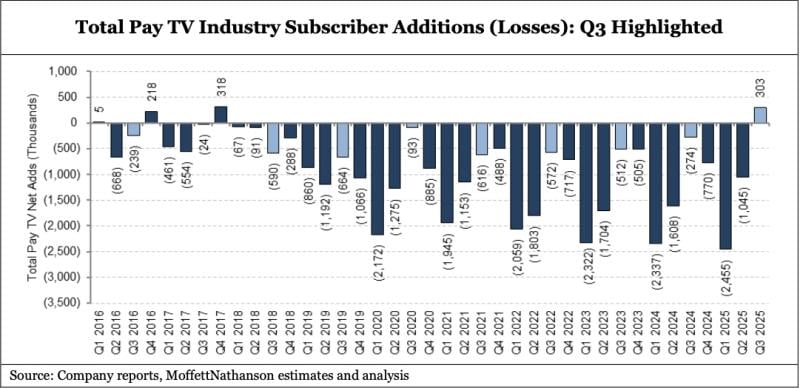
Cable Channel Subscribers Grew For the First Time In 8 Years Last Quarter (arstechnica.com) 21

An anonymous reader quotes a report from Ars Technica: On Monday, research analyst MoffettNathanson released its "Cord-Cutting Monitor Q3 2025: Signs of Life?" report. It found that the pay TV operators, including cable companies, satellite companies, and virtual multichannel video programming distributors (vMVPDs) like YouTube TV and Fubo, added 303,000 net subscribers in Q3 2025. According to the report, "There are more linear video subscribers now than there were three months ago. That's the first time we've been able to say that since 2017."

In Q3 2017, MoffettNathanson reported that pay TV gained 318,000 net new subscribers. But since then, the industry's subscriber count has been declining, with 1,045,000 customers in Q2 2025, as depicted in the graph [here]. The world's largest vMVPD by subscriber count, YouTube TV, claimed 8 million subscribers in February 2024; some analysts estimate that number is now at 9.4 million. In its report, MoffettNathanson estimated that YouTube TV added 750,000 subscribers in Q3 2025, compared to 1 million in Q3 2024.

Traditional pay TV companies also contributed to the industry's unexpected growth by bundling its services with streaming subscriptions. Charter Communications offers bundles with nine streaming services, including Disney+, Hulu, and HBO Max. In Q3 2024, it saw net attrition of 294,000 customers, compared to about 70,000 in Q3 2025. Other cable companies have made similar moves. Comcast, for example, launched a streaming bundle with Netflix, Peacock, and Apple TV in May 2024. For Q3 2025, Comcast reported its best pay TV subscriber count in almost five years, which was a net loss of 257,000 customers.
"Traditional pay TV -- i.e. cable and satellite -- still declined quarter over quarter in Q3, but again, by less," noted SteamTV Insider. "The [year-over-year] rate of attrition dropped from -12.4 percent to -10.2 percent over 12 months."

MoffettNathanson added: "Yes, Q3 saw a positive net add number for [pay TV for] the first time in eight years, but that positive result came in the year's seasonally strongest quarter. We're not yet close to seeing the category actually grow again..."
Television

Paramount Skydance Launches Hostile Bid For WBD After Netflix Wins Bidding War (cnbc.com) 66

Paramount Skydance is launching a hostile bid to buy Warner Bros. Discovery after it lost out to Netflix in a months-long bidding war for the legacy assets, the company said Monday. CNBC: Paramount will go straight to WBD shareholders with an all-cash, $30-per-share offer. That's the same bid WBD rejected last week, according to people familiar with the bid who asked not to be named because the details were private. The offer is backstopped with equity financing from the Ellison family and the private-equity firm RedBird Capital and $54 billion of debt commitments from Bank of America, Citi and Apollo Global Management.

"We're really here to finish what we started," Ellison told CNBC's "Squawk on the Street" Monday. "We put the company in play." On Friday, Netflix announced a deal to acquire WBD's studio and streaming assets for $72 billion. David Ellison-run Paramount had been bidding for the entirety of Warner Bros. Discovery, including those assets and the company's TV networks like CNN and TNT Sports.

Movies

Is Netflix Trying to Buy Warner Bros. or Kill It? (variety.com) 58

Why does Netflix want to buy Warner Bros, asks the chief film critic at the long-running motion-picture magazine Variety. "It is hard, at this moment, to resist the suspicion that the ultimate reason... is to eliminate the competition." [Warner Bros. is] one of the only companies that's keeping movies as we've known them alive... Some people think movies are going the way of the horse-and-buggy. A company like Warner Bros. has been the tangible proof that they're not. Ted Sarandos, the co-CEO of Netflix, has a different agenda. He has been unabashed about declaring that the era of movies seen in movie theaters is an antiquated concept. This is what he believes — which is fine. I think a more crucial point is that this is what he wants.

The Netflix business strategy isn't simply about being the most successful streaming company. It's about changing the way people watch movies; it's about replacing what we used to call moviegoing with streaming. (You could still call it moviegoing, only now you're just going into your living room.) It in no way demonizes Sarandos — he'd probably take it as a compliment — to say that there's a world-domination aspect to the Netflix grand strategy. Sarandos's vision is to have the entire planet wired, with everyone watching movies and shows at home. There's a school of thought that sees this an advance, a step forward in civilization. "Remember the days when we used to have to go out to a movie theater? How funny! Now you can just pop up a movie — no trailers! — with the click of a remote...."

Once he owns Warner Bros., will Sarandos keep using the studio to make movies that enjoy powerful runs in theaters the way Sinners and Weapons and One Battle After Another did? In the statement he made to investors and media today, Sarandos said, "I'd say right now, you should count on everything that is planned on going to the theater through Warner Bros. will continue to go to the theaters through Warner Bros." He added, "But our primary goal is to bring first-run movies to our members, because that's what they're looking for." Not exactly a ringing declaration of loyalty to the religion of cinema. And given Sarandos's track record, there is no reason to believe that he will suddenly change his spots.

A letter sent to Congress by a group of anonymous Hollywood producers, who voiced "grave concerns" about Netflix buying Warner Bros., stated, "They have no incentive to support theatrical exhibition, and they have every incentive to kill it." If that happens, though, I have no doubt that Sarandos will be smart enough to do it gradually. Warner Bros. films will probably be released in a "normal" fashion...for a while. Maybe a year or two. But five years from now? There is good reason to believe that by then, a "Warner Bros. movie," even a DC comic-book extravaganza, would be a streaming-only release, or maybe a two-weeks-in-theaters release, all as a more general way of trying to shorten the theatrical window, which could be devastating to the movie business.

Do we know all this to be true? No, but the indicators are somewhat overpowering. (He's been explicit about the windows...)

An anonymous group of "concerned feature film producers" sent an open letter to Congress warning Netflix would "effectively hold a noose around the theatrical marketplace," reports Variety.

And CNN also got this quote from Cinema United, a trade association that represents more than 30,000 movie screens in the United States. "Netflix's stated business model does not support theatrical exhibition," Cinema United President/CEO Michael O'Leary said in a statement. "In fact, it is the opposite."
Television

Could Netflix's Deal for Warner Bros. Fall Apart? (cnbc.com) 54

While Netflix hopes to buy Warner Bros. Discovery for $72 billion, CNBC reports a senior official in America's federal government said the administration was viewing the deal with "heavy skepticism. And that's not the only hurdle: On Thursday, The Wall Street Journal reported that Paramount, in a letter to lawyers for Warner Bros. Discovery [WBD], had warned that a sale to Netflix likely would "never close" because of regulatory challenges in the United States and overseas. "Acquiring Warner's streaming and studio assets 'will entrench and extend Netflix's global dominance in a matter not allowed by domestic or foreign competition laws,' Paramount's lawyers wrote," the Journal reported.
Paramount "is now weighing its options about whether to go straight to shareholders with one more improved bid," CNBC reported Friday, "perhaps even higher than the $30-per-share, all-cash offer it submitted to Warner Bros. Discovery this week."

And CNBC reported Friday that the review by America's Department of Justice "can take anywhere from months to more than a year." Netflix said Friday it expects the transaction to close in 12 to 18 months, after Warner Bros. Discovery spins out its portfolio of cable networks into Discovery Global... As part of the deal, Netflix has agreed to pay a $5.8 billion breakup fee to Warner Bros. Discovery if the deal were to get blocked by the government.
Netflix's planned move is already drawing high-powered criticism, reports CNN:
  • "The world's largest streaming company swallowing one of its biggest competitors is what antitrust laws were designed to prevent. The outcome would eliminate jobs, push down wages, worsen conditions for all entertainment workers, raise prices for consumers, and reduce the volume and diversity of content for all viewers...." the Writers Guild of America union representing Hollywood writers.
  • "Producers are rightfully concerned... Our legacy studios are more than content libraries — within their vaults are the character and culture of our nation." — The Producers Guild of America
  • The deal raises "many serious questions" about the entertainment industry's future, "especially the human creative talent whose livelihoods and careers depend on it." — SAG-AFTRA, Hollywood's biggest actors union
  • "This is not a win for consumers. Netflix has already aggressively raised prices, increased ad load, and stopped people from sharing passwords. Absorbing a competitor with strong content will only lead to its service becoming more expensive and give consumers less choice." — Ross Benes, a senior analyst at eMarketer, told CNN. [Benes also thinks this could mean fewer companies spending heavily on movies and TV shows. "This contracts the industry."

Slashdot Top Deals