The Almighty Buck

Blowing On Money To Tell If It Is Counterfeit 114

HughPickens.com writes Scientific American reports that simply breathing on money could soon reveal if it's the real deal or counterfeit thanks to a photonic crystal ink developed by Ling Bai and Zhongze Gu and colleagues at Southeast University in Nanjing, China that can produce unique color changing patterns on surfaces with an inkjet printer system which would be extremely hard for fraudsters to reproduce. The ink mimics the way Tmesisternus isabellae – a species of longhorn beetle – reversibly switches its color from gold to red according to the humidity in its environment. The color shift is caused by the adsorption of water vapor in their hardened front wings, which alters the thickness and average refractive index of their multilayered scales. To emulate this, the team made their photonic crystal ink using mesoporous silica nanoparticles, which have a large surface area and strong vapor adsorption capabilities that can be precisely controlled. The complicated and reversible multicolor shifts of mesoporous CPC patterns are favorable for immediate recognition by naked eyes but hard to copy. "We think the ink's multiple security features may be useful for antifraud applications," says Bai, "however we think the technology could be more useful for fabricating multiple functional sensor arrays, which we are now working towards."
The Courts

Court Shuts Down Alleged $120M Tech Support Scam 129

wiredmikey writes A federal court has temporarily shut down and frozen the assets of two telemarketing operations accused by the FTC of scamming customers out of more than $120 million by deceptively marketing computer software and tech support services. According to complaints filed by the FTC, since at least 2012, the defendants used software designed to trick consumers into believing there were problems with their computers and then hit them with sales pitches for tech support products and services to fix their machines.

According to the FTC, the scams began with computer software that claimed to improve the security or performance of the customer's computer. Typically, consumers downloaded a free, trial version of the software that would run a computer system scan. The scan always identified numerous errors, whether they existed or not. Consumers were then told that in order to fix the problems they had to purchase the paid version of the software for between $29 and $49. In order to activate the software after the purchase, consumers were then directed to call a toll-free number and connected to telemarketers who tried to sell them unneeded computer repair services and software, according to the FTC complaint. The services could cost as much as $500, the FTC stated.
Yahoo!

Firefox Signs Five-Year Deal With Yahoo, Drops Google as Default Search Engine 400

mpicpp writes with news that Yahoo will soon become the default search engine in Firefox. Google's 10-year run as Firefox's default search engine is over. Yahoo wants more search traffic, and a deal with Mozilla will bring it. In a major departure for both Mozilla and Yahoo, Firefox's default search engine is switching from Google to Yahoo in the United States. "I'm thrilled to announce that we've entered into a five-year partnership with Mozilla to make Yahoo the default search experience on Firefox across mobile and desktop," Yahoo Chief Executive Marissa Mayer said in a blog post Wednesday. "This is the most significant partnership for Yahoo in five years." The change will come to Firefox users in the US in December, and later Yahoo will bring that new "clean, modern and immersive search experience" to all Yahoo search users. In another part of the deal, Yahoo will support the Do Not Track technology for Firefox users, meaning that it will respect users' preferences not to be tracked for advertising purposes. With millions of users who perform about 100 billion searches a year, Firefox is a major source of the search traffic that's Google's bread and butter. Some of those searches produce search ads, and Mozilla has been funded primarily from a portion of that revenue that Google shares. In 2012, the most recent year for which figures are available, that search revenue brought in the lion's share of Mozilla's $311 million in revenue.
United States

Congress Suggests Moat, Electronic Fence To Protect White House 213

PolygamousRanchKid writes Acting Secret Service director Joseph Clancy on Wednesday faced a number of tough questions from the House Judiciary Committee about the fence jumper who made it deep into the White House. But along with the tough questions, Clancy fielded a couple eyebrow raising suggestions on how to better protect the president's home. "Would a moat, water six feet around, be kind of attractive and effective?" Rep. Steve Cohen, D-Tenn., asked with trepidation. Rep. Louie Gohmert, R-Texas, asked: “Would you be in favor of removing the fence around the White House and having, maybe, a virtual or electronic fence around it?” Clancy liked the moat idea better than the electric fence. “My knee-jerk reaction to that would be no, sir,” he told Gohmert. “Partly because of the number of tourists that come up Pennsylvania Avenue and come up to that area.”
United States

Number of Coders In Congress To Triple (From One To Three) 163

jfruh writes Last weekend, Tim Berners-Lee said that the UK needs more members of parliament who can code. Well, the most recent U.S. congressional election has obliged him on this side of the Atlantic: the number of coders in Congress has tripled, with the downside being that their numbers have gone from one to three.
The Internet

Head of FCC Proposes Increasing Internet School Fund 107

Rambo Tribble writes: The commissioners at the FCC are expected to vote, on December 11, on a proposal by Chairman Tom Wheeler to increase the funding for the nation's largest educational technology subsidy program, E-Rate, by 62 percent. The proposal is intended to be paid for by higher fees on phone service. The increased cost is pegged at $1.92 a year, per telephone line. Support for the proposal, or lack thereof, appears to be falling along partisan lines. To quote Wheeler, however, "Almost two-thirds of American schools cannot appropriately connect their students to the 21st century."
Republicans

Republicans Block Latest Attempt At Curbing NSA Power 445

Robotron23 writes: The latest attempt at NSA reform has been prevented from passage in the Senate by a margin of 58 to 42. Introduced as a means to stop the NSA collecting bulk phone and e-mail records on a daily basis, the USA Freedom Act has been considered a practical route to curtailment of perceived overreach by security services, 18 months since Edward Snowden went public. Opponents to the bill said it was needless, as Wall Street Journal raised the possibility of terrorists such as ISIS running amok on U.S. soil. Supporting the bill meanwhile were the technology giants Google and Microsoft. Prior to this vote, the bill had already been stripped of privacy protections in aid of gaining White House support. A provision to extend the controversial USA Patriot Act to 2017 was also appended by the House of Representatives.
Debian

Debian Votes Against Mandating Non-systemd Compatibility 581

paskie writes: Voting on a Debian General Resolution that would require packagers to maintain support even for systems not running systemd ended tonight with the resolution failing to gather enough support.

This means that some Debian packages could require users to run systemd on their systems in theory — however, in practice Debian still works fine without systemd (even with e.g. GNOME) and this will certainly stay the case at least for the next stable release Jessie.

However, the controversial general resolution proposed late in the development cycle opened many wounds in the community, prompting some prominent developers to resign or leave altogether, stirring strong emotions — not due to adoption of systemd per se, but because of the emotional burn-out and shortcomings in the decision processes apparent in the wake of the systemd controversy.

Nevertheless, work on the next stable release is well underway and some developers are already trying to mend the community and soothe the wounds.
United Kingdom

UK Hotel Adds Hefty Charge For Bad Reviews Online 307

Bizzeh writes: A British couple has been "fined" £100 by a Blackpool hotel for leaving critical comments on Trip Advisor. The UK's Trading Standards organization is investigating the incident, saying it may breach regulations. The Broadway Hotel's booking policy reads (in small print), "Despite the fact that repeat customers and couples love our hotel, your friends and family may not. "For every bad review left on any website, the group organizer will be charged a maximum £100 per review."
Canada

City of Toronto Files Court Injunction Against Uber 169

Sebolains writes: The city of Toronto in Ontario, Canada has filed a court injunction on Uber Canada Inc. today that requests for all operations in the city to cease. Uber has been operating there since 2012 without a license from the city, and so officials are concerned that Uber's operations pose a risk to both drivers and riders. How quickly this will happen, we don't know, but the city has asked the courts to be expedient in hearing this application.
Power

Rooftop Solar Could Reach Price Parity In the US By 2016 516

Lucas123 writes: The cost of rooftop solar-powered electricity will be on par with prices of coal-powered energy and other conventional sources in all 50 U.S. states in just two years, a leap from today where PV energy has price parity in only 10 states, according to Deutsche Bank's leading solar industry analyst. The sharp decline in solar energy costs is the result of increased economies of scale leading to cheaper photovoltaic panels, new leasing models and declining installation costs, Deutsche Bank's Vishal Shah stated in a recent report. The cost of solar-generated electricity in the top 10 states for capacity ranges from 11-15 cents per kilowatt hour (c/kWh), compared to the retail electricity price of 11-37 c/kWh. Amit Ronen, a former Congressional staffer behind legislation that created an investment tax credit for solar installations, said one of the only impediments to decreasing solar electricity prices are fees proposed by utilities on customers who install solar and take advantage of net metering, or the ability to sell excess power back to utilities.
Privacy

NYT: Privacy Concerns For ClassDojo, Other Tracking Apps For Schoolchildren 66

theodp writes: The NY Times' Natasha Singer files a report on popular and controversial behavior tracking app ClassDojo, which teachers use to keep a running tally of each student's score, award virtual badges for obedience, and to communicate with parents about their child's progress. "I like it because you get rewarded for your good behavior — like a dog does when it gets a treat," was one third grader's testimonial. Some parents, teachers and privacy law scholars say ClassDojo (investors) — along with other unproven technologies that record sensitive information about students — is being adopted without sufficiently considering the ramifications for data privacy and fairness. "ClassDojo," writes Singer, "does not seek explicit parental consent for teachers to log detailed information about a child's conduct. Although the app's terms of service state that teachers who sign up guarantee that their schools have authorized them to do so, many teachers can download ClassDojo, and other free apps, without vetting by school supervisors. Neither the New York City nor Los Angeles school districts, for example, keep track of teachers independently using apps."

A high school teacher interviewed for the article confessed to having not read ClassDojo's policies on handling student data, saying: "I'm one of those people who, when the terms of service are 18 pages, I just click agree." And, if all this doesn't make you parents just a tad nervous, check out this response to the "Has anyone ran a data analysis on their CD data?" question posed to the Class Dojo Community: "I needed to analyze data in regards to a student being placed on ADHD medicine to see whether or not he made any improvements. I have also used it to determine any behavioral changes depending on if a student was with mom/dad for a custody review. I use dojo consistently, so I LOVE getting to use the data to evaluate and share with parents, or even administrators."
Education

Ask Slashdot: Professionally Packaged Tools For Teaching Kids To Program? 107

Binestar writes: I've been doing IT consulting for years, but I'm not a programmer beyond bash scripting, perl scripts to make administration easier, and batch files to make Windows easier. I recently found an online course for modding Minecraft that my 9-year-old daughter is really enjoying (she built a custom sword that shoots lightning). Does anyone have any recommendations on online courses that would be age appropriate and worth the investment? It's been easy to get her interested in the Minecraft modding course because, as any parent with young children knows, Minecraft is kinda popular...

The course she's taking now is teaching her Eclipse and Gimp, and I'm sure there are other tools installed that they haven't had her open yet. What other vendors have stuff worth introducing her to? I've also started looking at things like the Kano and Learn to Mod, but as a non-programmer, I'm not really sure which are most useful for introduction and which are accomplishing what they claim vs. being a waste of money/time.

Anyone have experience or suggestions to help sort this out?
Australia

Laser Creates Quantum Whirlpool 59

Quantus347 writes: Physicists at The Australian National Univ. (ANU) have engineered a spiral laser beam and used it to create a whirlpool of hybrid light-matter particles called polaritons. Polaritons are hybrid particles that have properties of both matter and light. The ability to control polariton flows in this way could aid the development of completely novel technology to link conventional electronics with new laser- and fiber-based technologies. Polaritons form in semiconductors when laser light interacts with electrons and holes (positively charged vacancies) so strongly that it is no longer possible to distinguish light from matter.
Bitcoin

US Marshals Auctioning $20M Worth of Silk Road's Bitcoins 119

coondoggie writes: The U.S. Marshals office says it will auction off almost 50,000 bitcoins (about $20 million worth) seized from alleged Silk Road creator Ross Ulbricht. The auction, which is the second sale of Silk Road's bitcoin collection, will take place during a 6-hour period on Dec. 4 from 8:00 a.m. until 2:00 p.m. EST. Bids will be accepted by email from pre-registered bidders only, the U.S. Marshals office said. In June more than $17 million in bitcoins seized from the Silk Road take-down were auctioned off.
Linux Business

Crowdfunded Linux Voice Magazine Releases First Issue CC-BY-SA 62

M-Saunders (706738) writes Linux Voice, the crowdfunded GNU/Linux magazine that Slashdot has covered previously, had two goals at its launch: to give 50% of its profits back to the community after one year, and release each issue's contents under the Creative Commons after nine months. Well, it's been nine months since issue 1, so the whole thing is now online and free to share. Readers and supporters have also made audio versions of articles, for listening to on the commute to work.
The Media

Uber Threatens To Do 'Opposition Research' On Journalists 299

Nerval's Lobster writes A senior executive at Uber reportedly told a Buzzfeed writer that the company "should consider hiring a team of opposition researchers to dig up dirt on its critics in the media — and specifically to spread details of the personal life of a female journalist who has criticized the company." As detailed by the executive, Uber would spend a million dollars on the effort, which would involve "four top opposition researchers and four journalists," and dig into personal lives and families. Uber has pushed back against the report, insisting that it's never done opposition research, but the idea of any company engaging in such practices seems more like something Nixon would have dreamed up at his worst than a strategy by a "disruptive" startup.
Google

Court Rules Google's Search Results Qualify As Free Speech 137

wabrandsma writes with this news from Ars Technica: The regulation of Google's search results has come up from time to time over the past decade, and although the idea has gained some traction in Europe (most recently with "right to be forgotten" laws), courts and regulatory bodies in the U.S. have generally agreed that Google's search results are considered free speech. That consensus was upheld last Thursday, when a San Francisco Superior Court judge ruled in favor of Google's right to order its search results as it sees fit.
Books

Machine-Learning Algorithm Ranks the World's Most Notable Authors 55

HughPickens.com writes: Every year the works of thousands of authors enter the public domain, but only a small percentage of these end up being widely available. So how do organizations such as Project Gutenberg choose which works to focus on? Allen Riddell has developed an algorithm that automatically generates an independent ranking of notable authors for any given year. It is then a simple task to pick the works to focus on or to spot notable omissions from the past. Riddell's approach is to look at what kind of public domain content the world has focused on in the past and then use this as a guide to find content that people are likely to focus on in the future.

Riddell's algorithm begins with the Wikipedia entries of all authors in the English language edition (PDF)—more than a million of them. His algorithm extracts information such as the article length, article age, estimated views per day, time elapsed since last revision, and so on. This produces a "public domain ranking" of all the authors that appear on Wikipedia. For example, the author Virginia Woolf has a ranking of 1,081 out of 1,011,304 while the Italian painter Giuseppe Amisani, who died in the same year as Woolf, has a ranking of 580,363. So Riddell's new ranking clearly suggests that organizations like Project Gutenberg should focus more on digitizing Woolf's work than Amisani's. Of the individuals who died in 1965 and whose work will enter the public domain next January in many parts of the world, the new algorithm picks out TS Eliot as the most highly ranked individual. Others highly ranked include Somerset Maugham, Winston Churchill, and Malcolm X.
Programming

Do Good Programmers Need Agents? 215

braindrainbahrain writes: A rock star needs an agent, so maybe a rock star programmer needs one, too. As described in The New Yorker, a talent agency called 10x, which got started in the music business, is not your typical head hunter/recruiter agency. "The company's name comes from the idea, well established in the tech world, that the very best programmers are superstars, capable of achieving ten times the productivity of their merely competent colleagues." The writer talks with a number of programmers using agents to find work, who generally seem pleased with it, though the article has viewpoints from skeptics as well.
Privacy

Tor Eyes Crowdfunding Campaign To Upgrade Its Hidden Services 106

apexcp writes The web's biggest anonymity network is considering a crowdfunding campaign to overhaul its hidden services. From the article: "In the last 15 months, several of the biggest anonymous websites on the Tor network have been identified and seized by police. In most cases, no one is quite sure how it happened. The details of such a campaign have yet to be revealed. With enough funding, Tor could have developers focusing their work entirely on hidden services, a change in developer priorities that many Tor users have been hoping for in recent years."
Transportation

Toyota Names Upcoming Hydrogen Fuel Cell Car 194

An anonymous reader writes Toyota has announced the name of its new hydrogen-powered car: Mirai, which means "future" in Japanese. Toyota CEO Akio Toyoda said: "Today, we are at a turning point in automotive history. A turning point where a four-door sedan can travel 300 miles on a single tank of hydrogen, can be refueled in under five minutes and emit only water vapor."
Education

Coding Bootcamps Presented As "College Alternative" 226

ErichTheRed writes Perhaps this is the sign that the Web 2.0 bubble is finally at its peak. CNN produced a piece on DevBootcamp, a 19-week intensive coding academy designed to turn out Web developers at a rapid pace. I remember Microsoft and Cisco certification bootcamps from the peak of the last tech bubble, and the flood of under-qualified "IT professionals" they produced. Now that developer bootcamps are in the mainsteam media, can the end of the bubble be far away?
Canada

What the US Can Learn From Canada's Internet Policy 144

blottsie writes As the U.S. continues to debate how best to establish net neutrality regulations over Internet service providers, author and journalist Peter Nowak explains how how Canada has already dealt with these issues, and what the U.S. can learn from its neighbor to the north."[Canadian Prime Minister Stephen] Harper has made the connection between telecom policy and actual votes, and that has had enormous impact on public policy," says Michael Geist, the Canada Research Chair in internet and e-commerce law at the University of Ottawa. "This is a ballot-box or pocket-book issue that hasn't really been seen yet in the United States."
Biotech

Group Tries To Open Source Seeds 100

jenwike writes The Open Source Seed Initiative is a passionate group that wants to ensure their seeds are never patented, but making sure seeds are free for use and distribution by anyone isn't as easy as you might think. Part of the equation are plant characteristics, like an extended head on lettuce — is that an invention? Or, would you argue that it is the product of the collective sharing of material that improves the whole crop over time? In this report, one farmer says, "If you're not exchanging germplasm, you're cutting your own throat."
Communications

Military Laser/Radio Tech Proposed As Alternative To Laying Costly Fiber Cable 150

An anonymous reader writes "Californian comm-tech company Aoptix is testing new laser+radio hybrid communications technology with three major U.S. internet carriers. The equipment required can be bolted onto existing infrastructure, such as cell-tower masts, and can communicate a 2gbps stream over 6.5 miles. The system was developed over 10 years at a cost of $100 million in conjunction with the Air Force Research Laboratory, and the military implementation of it is called Aoptix Enhanced Air Ground Lasercom System (EAGLS). The laser component of the technology uses a deformable mirror to correct for atmospheric distortion over the mast-hop, in real-time. The laser part of the system is backed-up by a redundant radio transmitter. The radio component has low attenuation in rainy conditions with large refracting raindrops, while the laser is more vulnerable to dense fog. The system, which features auto-stabilization to compensate for cell-tower movement and is being proposed as an alternative to the tremendous cost p/m of laying fiber cable, is being tested in Mexico and Nigeria in addition to the three ISP trials.
United States

State Department Joins NOAA, USPS In Club of Hacked Federal Agencies 54

Hot on the heels of recent cyber attacks on NOAA, the USPS, and the White House, the New York Times reports that the U.S. State Department has also suffered an online security breach, though it's not clear who to blame. “This has impacted some of our unclassified email traffic and our access to public websites from our main unclassified system,” said one senior State Department official, adding that the department expected its systems to be up soon. ....The breach at the White House was believed to be the work of hackers in Russia, while the breaches at NOAA and the Postal Service were believed to the work of hackers inside China. Attributing attacks to a group or nation is difficult because hackers typically tend to route their attack through compromised web servers all over the world. A senior State Department official said the breach was discovered after “activity of concern” was detected on portions of its unclassified computer system. Officials did not say how long hackers may have been lurking in those systems, but security improvements were being added to them on Sunday.
United Kingdom

World's Youngest Microsoft Certificated Professional Is Five Years Old 276

HughPickens.com writes Gurvinder Gill writes at BBC that Ayan Qureshi is the world's youngest Microsoft Certified Professional after passing the tech giant's exam when he was just five years old. Qureshi's father introduced his son to computers when he was three years old. He let him play with his old computers, so he could understand hard drives and motherboards. "I found whatever I was telling him, the next day he'd remember everything I said, so I started to feed him more information," Qureshi explained. "Too much computing at this age can cause a negative effect, but in Ayan's case he has cached this opportunity." Ayan has his own computer lab at his home in Coventry, containing a computer network which he built and spends around two hours a day learning about the operating system, how to install programs, and has his own web site.

Microsoft Certified Professional (MCP) is a certification that validates IT professional and developer technical expertise through rigorous, industry-proven, and industry-recognized exams. MCP exams cover a wide range of Microsoft products, technologies, and solutions. When the boy arrived to take the Microsoft exam, the invigilators were concerned that he was too young to be a candidate. His father reassured them that Ayan would be all right on his own. "There were multiple choice questions, drag and drop questions, hotspot questions and scenario-based questions," Ayan's father told the BBC Asian Network. "The hardest challenge was explaining the language of the test to a five-year-old. But he seemed to pick it up and has a very good memory."
The Almighty Buck

Billionaire Donors Lavish Millions On Code.org Crowdfunding Project 84

theodp (442580) writes "Whether it's winning yacht races, assembling the best computer science faculty, or even dominating high school basketball, billionaires like to win. Which may help explain why three tech billionaires — Code.org backers (and FWD.us founders) Mark Zuckerberg, VC John Doerr, and Sean Parker — stepped up to the plate and helped out Code.org's once-anemic Hour of Code Indiegogo crowdfunding project with $500k donations. When matched by Code.org's largest donors (Bill Gates, Reid Hoffman and others), the three donations alone raised $3,000,000, enough to reach the organization's goal of becoming the most funded crowdfunding campaign ever on Indiegogo. On its campaign page, Code.org remarked that "to sustain our organization for the long haul, we need to engage parents and community members," which raises questions about how reliant the K-12 learn-to-code movement might be on the kindness of its wealthy corporate and individual donors. Code.org started shedding some light on its top donors a few months back, but contributor names are blank in the 2013 IRS 990 filing posted by the organization on its website, although GuideStar suggests the biggest contributors in 2013 were Microsoft ($3,149,411) and Code.org founders Hadi and Ali Partovi ($1,873,909 in Facebook stock). Coincidentally, in a Reddit AMA at Code.org's launch, CEO and Founder Hadi Partovi noted that his next-door-neighbor is Microsoft General Counsel and Code.org Board member Brad Smith, whose FWD.us bio notes is responsible for Microsoft's philanthropic work. Just months before Code.org and FWD.us emerged on the lobbying scene, Smith announced Microsoft's National Talent Strategy, which called for "an increase in developing the American STEM pipeline in exchange for these new [H-1B] visas and green cards," a wish that President Obama is expected to grant shortly via executive action."
Debian

Longtime Debian Developer Tollef Fog Heen Resigns From Systemd Maintainer Team 550

An anonymous reader writes Debian developer Tollef Fog Heen submitted his resignation to the Debian Systemd package maintainers team mailing list today (Sun. Nov. 16th, 2014). In his brief post, he praises the team, but claims that he cannot continue to contribute due to the "load of continued attacks...becoming just too much." Presumably, he is referring to the heated and, at times, even vitriolic criticism of Debian's adoption of Systemd as the default init system for its upcoming Jessie release from commenters inside and outside of the Debian community. Currently, it is not known if Tollef will cease contributing to Debian altogether. A message from his twitter feed indicates that he may blog about his departure in the near future.
Open Source

Open Source Self-Healing Software For Virtual Machines 50

An anonymous reader writes Computer scientists have developed Linux based software that not only detects and eradicates never-before-seen viruses and other malware, but also automatically repairs damage caused by them. If a virus or attack stops the service, A3 could repair it in minutes without having to take the servers down. The software then prevents the invader from ever infecting the computer again. "It's pretty cool when you can pick the Bug of the Week and it works." (Here's a paper with more details.)
Earth

MARS, Inc: We Are Running Out of Chocolate 323

schwit1 writes There's no easy way to say this: You're eating too much chocolate, all of you. And it's getting so out of hand that the world could be headed towards a potentially disastrous (if you love chocolate) scenario if it doesn't stop. ... Chocolate deficits, whereby farmers produce less cocoa than the world eats, are becoming the norm. Already, we are in the midst of what could be the longest streak of consecutive chocolate deficits in more than 50 years. It also looks like deficits aren't just carrying over from year-to-year—the industry expects them to grow. Last year, the world ate roughly 70,000 metric tons more cocoa than it produced. By 2020, the two chocolate-makers warn that that number could swell to 1 million metric tons, a more than 14-fold increase; by 2030, they think the deficit could reach 2 million metric tons.
GNOME

GTK+ Developers Call For Help To Finish Cross-Platform OpenGL Support 89

jones_supa writes OpenGL support under GTK is getting into good shape for providing a nice, out-of-the-box experience by default on key platforms for the GTK+ 3.16 / GNOME 3.16 release in March. For a few weeks now within mainline GTK+ has been native OpenGL support and as part of that a new GtkGLArea widget for allowing OpenGL drawing within GTK applications. Since that initial work landed, there's been more GTK+ OpenGL code progressing that right now primarily benefits Linux X11 and Wayland users. While good progress is being made and improvements still ongoing to the GNOME toolkit, GNOME developers are requesting help in ensuring other GTK+ backends can benefit from this OpenGL support. If you are using or planning to use GTK+ 3 on Windows or OS X, and you know how to use OpenGL on those two platforms, please consider helping out the GTK+ developers by implementing the GdkGLContext API using WGL and AppleGL.
Networking

Can the US Actually Cultivate Local Competition in Broadband? 135

New submitter riskkeyesq writes with a link to a blog post from Dane Jasper, CEO of Sonic.net, about what Jasper sees as the deepest problem in the U.S. broadband market and the Internet in general: "There are a number of threats to the Internet as a system for innovation, commerce and education today. They include net neutrality, the price of Internet access in America, performance, rural availability and privacy. But none of these are the root issue, they're just symptoms. The root cause of all of these symptoms is a disease: a lack of competition for consumer Internet access." Soft landings for former legislators, lobbyists disguised as regulators, hundreds of thousands of miles of fiber sitting unused, the sham that is the internet provider free market is keeping the US in a telecommunications third-world. What, exactly, can American citizens do about it? One upshot, in Jasper's opinion (hardly disinterested, is his role at CEO at an ISP that draws praise from the EFF for its privacy policies) is this: "Today’s FCC should return to the roots of the Telecom Act, and reinforce the unbundling requirements, assuring that they are again technology neutral. This will create an investment ladder to facilities for competitive carriers, opening access to build out and serve areas that are beyond our reach today."
Medicine

Machine Learning Used To Predict Military Suicides 74

HughPickens.com (3830033) writes David Wagner writes that a predictive computer model using machine learning methods is helping to identify soldiers in the United States Army most likely to commit suicide. Computers combed through data on more than 40,000 soldiers who'd been hospitalized for mental health problems looking at 421 variables on each soldier drawn from 38 military data systems. Using a method known as "machine learning," the researchers identified roughly two dozen factors that are most important in predicting soldiers most likely to commit suicide. The soldiers most likely to take their own lives were men with past suicidal behavior and a history of psychiatric disorders and criminal offenses, including weapons possession and verbal assaults. Soldiers with hearing loss also faced heightened risk — a strong indicator that they had suffered a head injury. So did enlisting in the Army after age 27, most likely because those soldiers had already experienced trouble finding their way in life. "There's this group that comes to the Army later in life — they're smart, they have skills, they tend not to be married and they have no career or have left a career to join," Dr. Kessler said. "We don't know why they should be at higher risk, but they appear to be."

Murray Stein, co-author of the new study, found that among soldiers recently discharged from psychiatric hospitals, more than half of suicides were committed by just five percent of patients. "The most impressive thing is that they identified this high-risk group in the hospital, and by just focusing on one in 20 of them, you're really dramatically improving your ability to predict," says Dr. Mark Olfson, a professor of psychiatry at Columbia University who was not involved in the study. "Clinicians don't do a very good job predicting suicide risk, even though we think we do."
Robotics

Low Cost Ground Robot Chassis That Can Traverse Challenging Obstacles 38

Hallie Siegel writes In order for a robot to be useful in our world, it must be able to traverse unpredictable obstacles, including stairs. But currently available robot chassis tend to be either too small or extremely expensive, and most platform kits cannot leave a controlled environment – a huge problem for makers who want to get outside the lab or workshop. This has been an extremely hard problem for roboticists to solve, but the Ground Drone Project wants to change all that with its low-cost ground robot chassis. Check out this innovative design. (Currently, the project is raising money through Kickstarter; if it succeeds, "the instructions and bill of materials will be available for all.")
Android

Visual Studio 2015 Supports CLANG and Android (Emulator Included) 192

Billly Gates (198444) writes "What would be unthinkable a decade ago is Visual Studio supporting W3C HTML and CSS and now apps on other platforms. Visual Studio 2015 preview is available for download which includes support for LLVM/Clang, Android development, and even Linux development with Mono using Xamarin. A little more detail is here. A tester also found support for Java, ANT, SQL LITE, and WebSocket4web. We see IE improving in terms of more standards and Visual Studio Online even supports IOS and MacOSX development. Is this a new Microsoft emerging? In any case it is nice to have an alternative to Google tools for Android development."
Supercomputing

US DOE Sets Sights On 300 Petaflop Supercomputer 127

dcblogs writes U.S. officials Friday announced plans to spend $325 million on two new supercomputers, one of which may eventually be built to support speeds of up to 300 petaflops. The U.S. Department of Energy, the major funder of supercomputers used for scientific research, wants to have the two systems – each with a base speed of 150 petaflops – possibly running by 2017. Going beyond the base speed to reach 300 petaflops will take additional government approvals. If the world stands still, the U.S. may conceivably regain the lead in supercomputing speed from China with these new systems. How adequate this planned investment will look three years from now is a question. Lawmakers weren't reading from the same script as U.S. Energy Secretary Ernest Moniz when it came to assessing the U.S.'s place in the supercomputing world. Moniz said the awards "will ensure the United States retains global leadership in supercomputing." But Rep. Chuck Fleischmann (R-Tenn.) put U.S. leadership in the past tense. "Supercomputing is one of those things that we can step up and lead the world again," he said.
The Military

Alleged Satellite Photo Says Ukraine Shootdown of MH17 340

theshowmecanuck (703852) writes A group calling itself the Russian Union of Engineers has published a photograph, picked up by many news organizations (just picked one, Google it yourself to find more), claiming to show that MH17 was shot down by a Ukrainian fighter plane. The interesting thing is the very quick ad hoc crowd sourced debunking of the photograph using tools from Google maps, online photos/data, to their own domain knowledge backed up with the previous information. It would be interesting to understand who the "Russian Union of Engineers" are and why they in particular were chosen to release this information.
Books

R. A. Montgomery, Creator of the "Choose Your Own Adventure" Books, Dead At 78 80

Dave Knott writes Raymond Almiran Montgomery, original publisher and author of the incredibly popular "Choose Your Own Adventure" book series for children, the 4th bestselling children's series of all time, has died at the age of 78. In 1975, Montgomery founded a small press and when, in 1977, Ed Packard submitted an innovative book for young readers, "Sugarcane Island", Montgomery immediately saw it for what it was: a role-playing game in book form. He leapt at the chance to publish it, and launched a series, writing the second book, "Journey Under The Sea", himself. When Montgomery went through a divorce and sold his stake in the press to his ex-wife, he took the series, renamed as "Choose Your Own Adventure", to Bantam. The books went on to sell more than 250 million copies across 230 titles in 40 languages. Montgomery's interests also extended to new technology, adapting the series to the Atari console in 1984. He was also responsible for the Comic Creator software on Apple's Macintosh computers. Montgomery died on November 9th. The cause of death was not disclosed.
Government

Comcast Kisses-Up To Obama, Publicly Agrees On Net Neutrality 258

MojoKid writes Comcast is one of two companies to have earned Consumerist's "Worst Company in America" title on more than one occasion and it looks like they're lobbying for a third title. That is, unless there's another explanation as to how the cable giant can claim (with straight face) that it's in agreement with President Barack Obama for a free and open Internet. Comcast issued a statement of its own saying they back the exact same things, it just doesn't want to go the utility route. Comcast went on to list specific bullet points that they're supposedly in wholehearted agreement with, such as: Free and open Internet. We agree — and that is our practice. No blocking. We agree — and that is our practice. No throttling. We agree — and that is our practice. Increased transparency. We agree — and that is our practice. No paid prioritization. We agree — and that is our practice. Really? Comcast conveniently fails to address the giant elephant in the room whose name is Netflix. Earlier this year, Netflix begrudgingly inked a multi-year deal with Comcast in which the streaming service agreed to pay a toll to ensure faster delivery into the homes of Comcast subscribers, who prior to the deal had been complaining of frequent buffering and video degradation when watching content on Netflix. Comcast would undoubtedly argue that it's not a paid fast lane, but it's hard to see the deal as anything other than that.
The Almighty Buck

The Downside to Low Gas Prices 554

HughPickens.com writes Pat Garofalo writes in an op-ed in US News & World Report that with the recent drop in oil prices, there's something policymakers can do that will offset at least some of the negative effects of the currently low prices, while also removing a constant thorn in the side of American transportation and infrastructure policy: Raise the gas tax. The current 18.4 cent per gallon gas tax has not been raised since 1993, making it about 11 cents per gallon today, in constant dollars. Plus, as fuel efficiency has gotten better and Americans have started driving less, the tax has naturally raised less revenue anyway. And that's a problem because the tax fills the Highway Trust Fund, which is, not to put too fine a point on it, broke so that in recent years Congress has had to patch it time and time again to fill the gap. According to the Tax Policy Center's Howard Gleckman, if Congress doesn't make a move, "it will fumble one of those rare opportunities when the economic and policy stars align almost perfectly." The increase can be phased in slowly, a few cents per month, perhaps, so that the price of gas doesn't jump overnight. When prices eventually do creep back up thanks to economic factors, hopefully the tax will hardly be noticed.

Consumers are already starting to buy the sort of gas-guzzling vehicles, including Hummers, that had been going out of style as gas prices rose; that's bad for both the environment and consumers, because gas prices are inevitably going to increase again. According to data from the U.S. Energy Information Administration, taxes last year, even before the current drop in prices, made up 12 percent of the cost of a gallon of gasoline, down from 28 percent in 2000. And compared to other developed countries, US gas taxes are pretty much a joke. While we're at it, an even better idea, as a recent report from the Urban Institute makes clear, would be indexing the gas tax to inflation, so this problem doesn't consistently arise. "The status quo simply isn't sustainable, from an infrastructure or environmental perspective," concludes Garofalo. "So raise the gas tax now; someday down the line, it will look like a brilliant move."
Bitcoin

Entrepreneur Injects Bitcoin Wallets Into Hands 77

wiredmikey writes A Dutch entrepreneur has had two microchips containing Bitcoin injected into his hands to help him make contactless payments. The chips, enclosed in a 2mm by 12mm capsule of "biocompatible" glass, were injected using a special syringe and can communicate with devices such as Android smartphones or tablets via NFC. "What's stored on the microchips should be seen as a savings account rather than a current account," Martijn Wismeijer, co-founder of MrBitcoin said. "The payment device remains the smartphone, but you transfer funds from the chips." The chips are available on the Internet, sold with a syringe for $99, but Wismeijer suggested individuals should find a specialist to handle the injection to avoid infections.
Education

Ask Slashdot: Programming Education Resources For a Year Offline? 223

An anonymous reader writes "I will be traveling to a remote Himalayan village for year and won't have access to the internet. What offline resources would you all recommend to help me continue to develop my coding skills? I think this would be a good time to get better at fundamentals, since I won't be able to learn any new frameworks or APIs. What about other, non-programming skills to practice and learn? Any ideas?" What would you bring?
The Courts

FCC Says Net Neutrality Decision Delay Is About Courts, Not Politics 60

blottsie writes with this news from The Daily Dot: "The Federal Communications Commission's seemingly suspicious timing in delaying its net neutrality decision has absolutely nothing to do with recent politics, according to an FCC official. Instead, it's a matter of some people in the agency insisting they be more prepared before going to court to defend their eventual plan. In January, the U.S. Court of Appeals in Washington, D.C., ruled in favor of Verizon, which challenged the FCC's 2010 Open Internet rules, striking down the agency's net neutrality protections. The court found that the FCC did not use the proper legal structure to establish its regulatory authority over broadband service—something that many legal experts say would not be the case if the FCC invokes Title II. The FCC's move to delay the net neutrality decision, which followed President Obama's support of Title II reclassification, was just a coincidence, according to the FCC official:" Before the president weighed in, several of our staff felt like the record was a little thin in areas, and the last thing you want when you go to court for the third time is for a court to say the record was too thin, or you didn't give adequate notice. We are going to be so careful this time that we have crossed every T and dotted every I. Some of the staff felt we're not quite there yet."
Earth

How To Mathematically Predict Lightning Strikes 41

rossgneumann writes Soon, it's very possible that when you say something like "you have better odds of being struck by lightning," that won't necessarily mean it's all that rare. And there's a good chance that you'll be able to tell that person (roughly) what the odds of that happening are. Research published this week in Nature provides an equation that is reasonably accurate at mathematically predicting lightning strikes. From the article: "There's not a whole lot of noise in Romps's estimates: CAPE [Convective Available Potential Energy] is something that can be predicted out fairly easily: "All [models] in our ensemble predict that [the United State's] mean CAPE will increase over the 21st century, with a mean increase of 11.2 percent per degree Celsius of global warming," he wrote. "Overall, the [models] predict a ~50 percent increase in the rate of lightning strikes in the United States over the 21st century."
Censorship

Cameron Says People Radicalized By Free Speech; UK ISPs Agree To Censor Button 316

An anonymous reader writes with this excerpt from Techdirt: A few years ago, we mocked then Senator Joe Lieberman's request that internet companies put "report this content as terrorist content" buttons on various types of online content. The plan went nowhere, because it's a really bad idea, prone to massive abuse. Yet, over in the UK, some apparently think it's such a grand idea that they're actually moving forward with it. This isn't a huge surprise — the current UK government has been going on for quite some time about banning "extremist" content, and just recently ramped up such efforts. And now it appears that a bunch of big UK broadband access providers have agreed to play along: The UK's major Internet service providers – BT, Virgin, Sky and Talk Talk – have this week committed to host a public reporting button for terrorist material online, similar to the reporting button which allows the public to report child sexual exploitation. They have also agreed to ensure that terrorist and extremist material is captured by their filters to prevent children and young people coming across radicalising material.
Google

Google Wallet API For Digital Goods Will Be Retired On March 2, 2015 105

An anonymous reader points out that Google plans to shut down Google Wallet API for third-party digital purchases. "Google has quietly revealed it plans to retire the Google Wallet API for digital goods on March 2, 2015. The company plans to continue supporting the sale of apps on Google Play as well as in-app payments, but users will not be able to purchase any virtual items offered on the Web through Google Wallet. We say "quietly" because there is no official announcement from Google. Furthermore, Google says it has no plans to proactively communicate the change to Google Wallet users; buyers will simply get 404 errors when trying to check out after support is pulled."
Education

Education Chief Should Know About PLATO and the History of Online CS Education 134

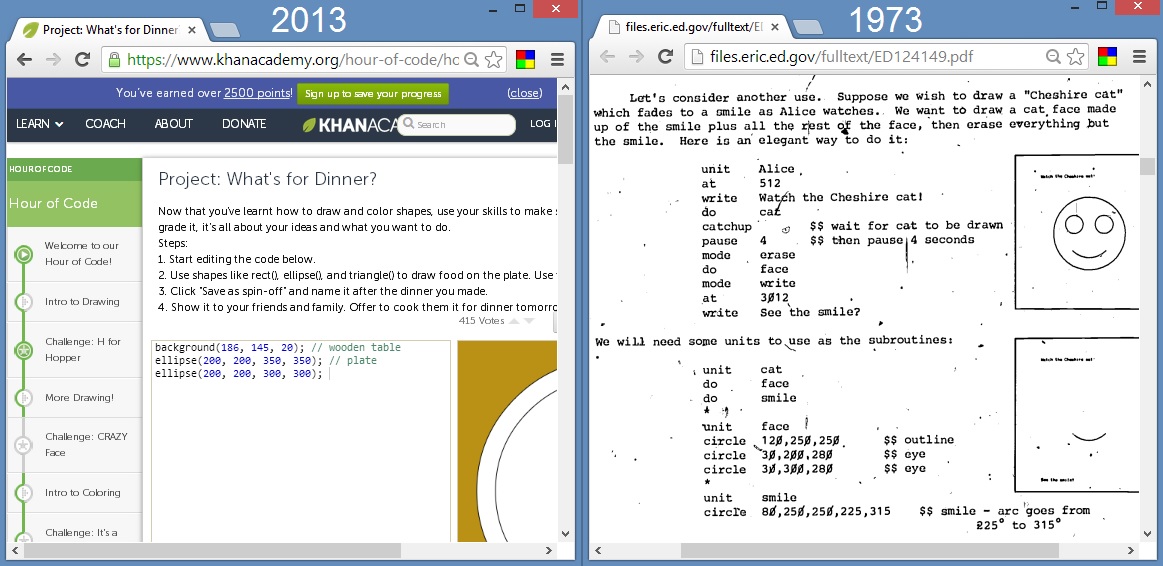
theodp writes Writing in Vanity Fair, U.S. Secretary of Education Arne Duncan marvels that his kids can learn to code online at their own pace thanks to "free" lessons from Khan Academy, which Duncan credits for "changing the way my kids learn" (Duncan calls out his kids' grade school for not offering coding). The 50-year-old Duncan, who complained last December that he "didn't have the opportunity to learn computer skills" while growing up attending the Univ. of Chicago Lab Schools and Yale, may be surprised to learn that the University of Illinois was teaching kids how to program online in the '70s with its PLATO system, and it didn't look all that different from what Khan Academy came up with for his kids 40 years later (Roger Ebert remarked in his 2011 TED Talk that seeing Khan Academy gave him a flashback to the PLATO system he reported on in the '60s). So, does it matter if the nation's education chief — who presides over a budget that includes $69 billion in discretionary spending — is clueless about The Hidden History of Ed-Tech? Some think so. "We can't move forward," Hack Education's Audrey Watters writes, "til we reconcile where we've been before." So, if Duncan doesn't want to shell out $200 to read a 40-year-old academic paper on the subject (that's a different problem!) to bring himself up to speed, he presumably can check out the free offerings at Ed.gov. A 1975 paper on Interactive Systems for Education, for instance, notes that 650 students were learning programming on PLATO during the Spring '75 semester, not bad considering that Khan Academy is boasting that it "helped over 2000 girls learn to code" in 2014 (after luring their teachers with funding from a $1,000,000 Google Award). Even young techies might be impressed by the extent of PLATO's circa-1975 online CS offerings, from lessons on data structures and numerical analysis to compilers, including BASIC, PL/I, SNOBOL, APL, and even good-old COBOL.
Sony

Sony To Take On Netflix With Playstation Vue 130

stephendavion writes "Sony is planning to launch PlayStation Vue, a TV service for PlayStation 3 and PlayStation 4 consoles providing on demand programs and live content. The company will roll out the service to selected customers in New York, Chicago, and Los Angeles, and is expected to feature content from CBS, Fox, NBC Universal, Discovery Communications and 75 other channels. The service is expected to allow users to save their programs for up to 28 days."

Slashdot Top Deals